Research Objective: De-mystifying "Range Anxiety"
A significant barrier to electric vehicle adoption is "range anxiety," fueled by the discrepancy between lab-tested range and real-world performance. This is especially true in regions with challenging terrain like Nepal. My research aimed to move beyond simplified models by conducting a rigorous on-road experiment to analyze the complex interplay of factors affecting EV energy consumption and develop a more accurate predictive framework.
My Role: Researcher & Data Analyst
As a primary author of this published paper, I managed the end-to-end research process. My responsibilities included:
- Experimental Design: Outfitting a custom-converted EV with GPS and Battery Management System (BMS) sensors to log high-fidelity, real-time performance data.
- Data Acquisition & Processing: Conducting on-road tests over a route with significant elevation changes and using MATLAB, Python, and Excel to synchronize and analyze the resulting data streams.
- Analytical Modeling: Applying physics-based principles to model the vehicle's energy dynamics, including aerodynamic drag, rolling resistance, and changes in kinetic and potential energy.
- Interpretation & Visualization: Identifying key data correlations, such as the crucial link between altitude and battery state of charge, and creating the data visualizations essential to the paper's findings.
Key Findings & Data-Driven Insights
The study yielded critical insights into EV performance, quantifying the real-world impact of variables that are often generalized in manufacturer estimates. The findings are summarized below.
1. The Critical Impact of Terrain on Battery Drain
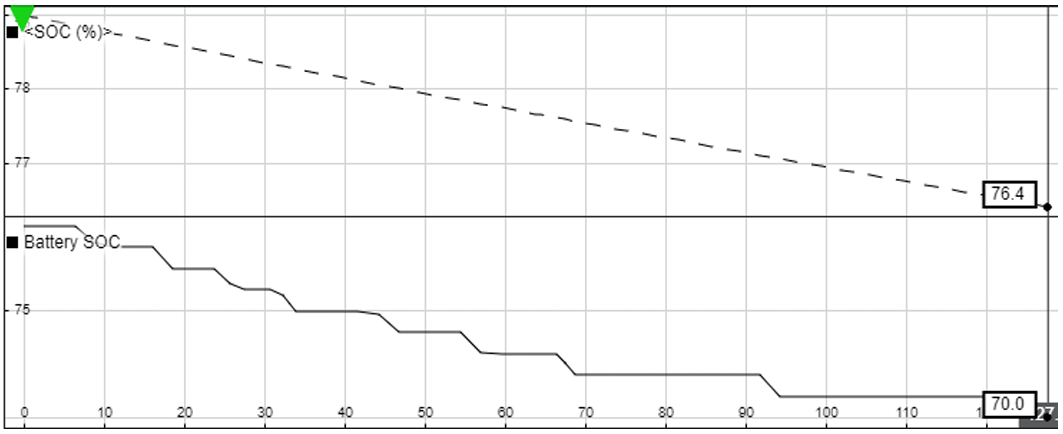
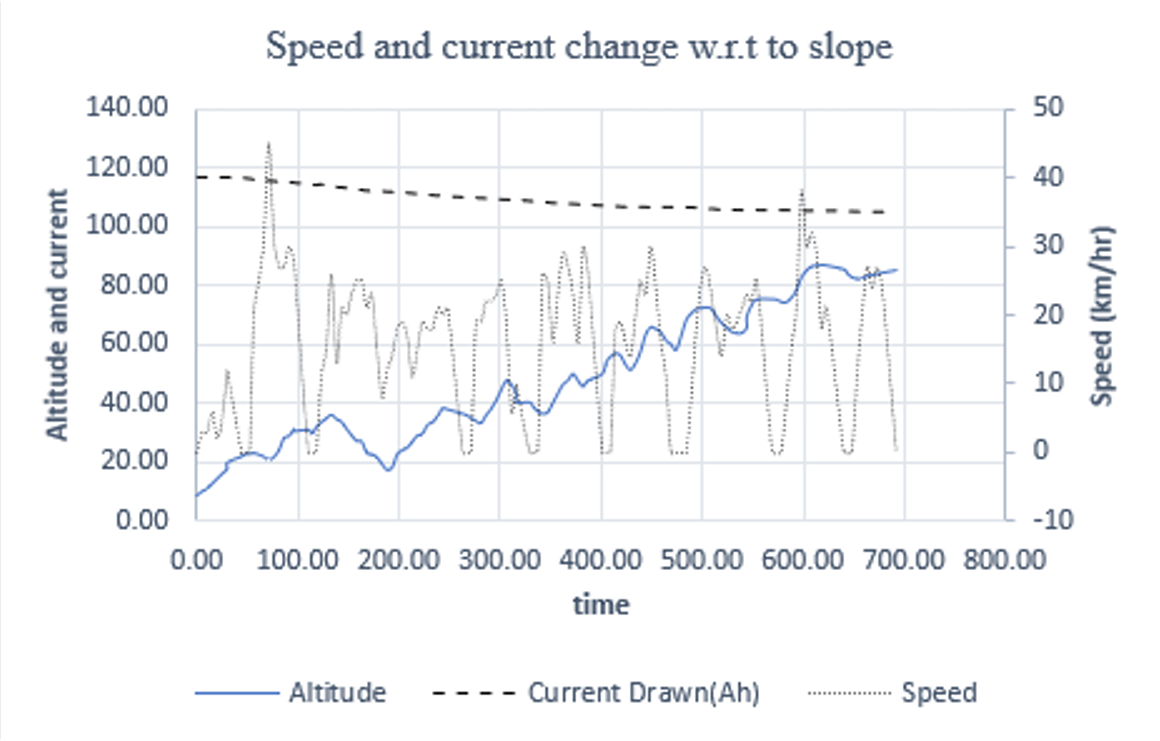
The analysis revealed a powerful negative Pearson's correlation coefficient of -0.89 between altitude and State of Charge (SOC). This data provides quantitative proof that climbing hills is a dominant factor in battery depletion, making it a critical variable for accurate range prediction in non-flat environments.
2. The Power of Regenerative Braking
Our model quantified a game-changing insight: an efficient regenerative braking system stron. We calculated the energy loss over the route to be 20.86 kWh without regeneration, which dropped to just 10.22 kWh with it enabled. This proves that regeneration is essential, not just an add-on, for practical EV efficiency.
3. Model Accuracy and Predictive Power
By using real-world GPS and BMS data in our physics-based model, our prediction for the final State of Charge at the destination was within 6% of the actual measured value. This level of accuracy showcases the superiority of comprehensive, data-driven modeling over simplified manufacturer estimates for predicting real-world vehicle range.